| music |
alivingdog.com |
 |
|
Music
Interview with Peter "Memory" Banks 21 Dec. 2005 by Gord
Wilson
|
| Der
Kommissar |
After the Fire |
 |
| left
to
right: Signs of Change (1978), Laser Love (1979), 80-f (1980),
Batteries Not Included (1982), Der Kommissar (compilation album,
1982), Der Kommissar: The CBS Recordings (double CD set includes
Laser Love, 80-f and No Batteries Required). |
| Q:
How’d the new ATF2 band come about? A:
In 2004 the fan club called Friends of After the Fire had a
reunion. John Russell and myself were going to answer some
questions. Andy Piercy couldn’t be there because of a work
committment. I had this idea that we should put a band
together and do karaoke with members of the fan club singing
their favorite After the Fire songs. And so John’s son Matt
was on drums and we recruited someone on bass who’d been a fan
of the band who we knew about, and that’s what we did, we put
together this line-up. We kind of worked on the songs
individually. We didn’t really play together until the night
of the fan club reunion. We did "Life in the City" as the
sound check, and it was just brilliant. Matt really mastered
the songs as a drummer, and the evening went really well. That
was phase one.
Phase
two. Pete Smith who worked with us in Zip Code had said he was
going to try and get to the reunion but he had a personal
committment and couldn’t make it. So I said how about doing a
whole set, because the guy who was stage managing the reunion
was stage manager at the Greenbelt Festival. We got excited to
play so we needed a singer, so Keith was the man. That’s how
we got back together again.
Q: I think on the ATF website there was something about how playing the Greenbelt festival went so well it got everyone bucked up. A:
Greenbelt went really well. That was going to be the one off
gig and that was it. About two weeks after that Keith sent me
some lyrics he’d written which summed up his feelings about
Greenbelt and doing the thing in the band. He was very much
aware what After the Fire was about and how we were in our
heyday, but he didn’t realize the affection the fans held for
us, because this was just a room of smiling, very happy people
when we played the show. It made a massive impression on him,
and he sent me the lyrics. That inspired me to write another
bit of music, so that’s how “Forged from Faith” was born. From
there we decided to just play half a dozen gigs a year and
have fun. That turned out to be the start, originally, with
just a one off.
Q: But you’d released “One Rule for You” before “Forged from Faith,” right? A:
Yes we did. Again that had a lot to do with Greenbelt 2004. We
played on the radio show, an unplugged set there, and I had
this rhythm thing going on the keyboard because there were
only the three of us, John, myself and Keith. So it was a
very, unplugged, impromptu couple of songs that we did. The
reaction to this was that everyone said, “Oh you must rerecord
“One Rule for You,” and it’’s always been a strong song, and
then the Christian Aid link came up, so we decided to modify
the words to match the Trade Justice campaign. At the time we
didn’t even know the Make Poverty History campaign would be
launched, and it was great because it tied in very much with
the campaign and was out in time for that and to pick up radio
play. We did a lot of interviews with the single coming out.
“Forged from Faith” was the first song written, but it wasn’t
the first song we recorded.
Q: That phrase, “One rule for you, one rule for me,” seems to be a characteristically way of saying it that a lot of Americans don’t get. A: It is a saying. So they don’t understand that? That’s interesting. That may be a cultural thing. Q: Was that song originally on No Batteries Required? A: No, “One Rule for You” was on Laser Love. That was actually our very first CBS release and our first single for CBS. Q: I think that single said on it that it benefits Trade for Justice. Is that correct? A:
Christian Aid and the Trade Justice campaign.That’s right. The
words were modified in conjunction with Christian Aid to
reflect the trade justice position.
Q: And what is that position? A:
The idea of trade justice is to try to get rid of the
subsidies. For instance, in America the rice farmers are
heavily subsidized which makes it very unfair for the third
world rice farmers because they can’t sell their crop because
the world market is so tweaked. Therefore they are trapped in
poverty and relative squalor in living conditions compared to
us in the west.
Q: Is that something like what Bono of U2 was doing? A:
Yes, that’s exactly what they were doing. The Make Poverty
History campaign had three elements, of which one was trade
justice. One was drop the debt, and the third one was more
aid. That’s very much what Bono and Bob Geldolf were about,
and what they are still campaigning for, because the trade
justice aspect America has not agreed to.
|
 |
 |
 |
| left
to
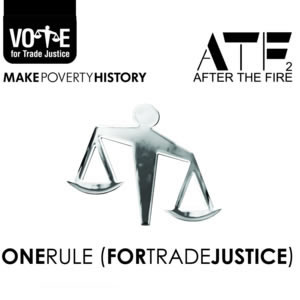
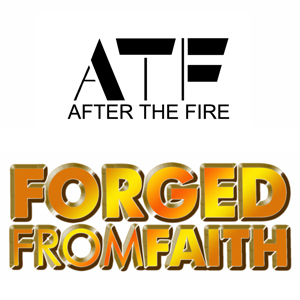
right: the radio station single of "One Rule For You," AidTF
logo, Radio single of "Forged from Faith." For more
information, click any picture to go to After the Fire's
website, afterthefire.co.uk. |
| Q:
You have something on your website called AidTF. A:
That’s right. That’s our own little project to raise money
for this Nayasora water project. That’s in conjunction
with the Soapbox Communications Trust, of which John
Russel, our guitarist is the chief executive officer.
Their main business is to encourage people to go out on
projects, and these individuals will raise their own
funds, and go out and work on a project in Africa or
Romania. There’s a huge number of sites where they take
these people out and they work on a physical project. The
water project is one of the projects. There are a number
of people raising funds for this. We’ve aligned ourselves
with that particular water project. AidTF is our website
to try and raise awareness and funds for that. We’ve had
somebody do a parachute jump. We’ve got businesses that
are offering money against purchases through their
websites and their businesses. And every sale that we make
through our own website, they get a pound per CD, which is
about 1.7 US dollars.
What’s
happened in this particular instance is they have already
built the clinic, but they cannot get the license to use
the clinic, and the doctors cannot use the clinic to treat
patients until they’ve got water. The initial funds are to
finance drilling for water. They’ve carried out all the
geological surveys and the evidence is there that there is
a very good possibility of there being water not too far
down, but it’s to pay for that initial drill. After that,
the funding goes on because there needs to be a pump to
bring the water to the surface. So it’s an ongoing
project.
Q: How are the singles going over musically? A:
We already have a very dedicated following from the old
days and happily we’re gradually getting younger people.
The children of the people from our fan club are coming to
see us, and in that way it’s great because we’ve got a new
audience as well as our original audience. The new
material is going down very well. There’s always a huge
risk when you’ve got a new line-up and you introduce new
songs, but thankfully, all good so far.
Q: Are you the only surviving member from the old band? A: No, John Russell is as well. Q:
I should think that with Der Kommissar: The CBS
Recordings, the double CD set that has all three of your
CBS albums on it being available now in the states it’s
almost like two new albums for listeners in the US.
A: That is a really good value package. It ‘s a great way to catch up on the After the Fire back catalog. Q: I’d say that most people know ATF from the song “Der Kommissar” that you co-wrote with Falco, and that’s being revived all over the radio right now. A: Do you think that’s hearkening back to the ‘80s period in rock music? Q:. I do. Over here the radio formats are quite restrictive right now, but that song falls across a couple different formats: pop, mid’’80s, classic rock. A:
That’s very much what After the Fire was about. We tried
to merge the ideas of pop music and rock music. This was a
deliberate policy: to not be too heavy and not be too
light. So we would try to have the weight of mainstream
rock, but with the tunes and the melodies of pop music.
What we did with “Der Kommissar,” that was originally a
hit track, the one by Falco, but it was quite lightweight.
We tried to really beef it up, give it some guts and
energy, and yet retain that kind of modern hip hop feel,
which at that time was quite a daring thing to do.
Q: Did you write the English lyrics for it? Because they’re quite good. A: Yes I did. Q: Isn’t there an earlier period where Andy Piercy revived After the Fire? A: After the band split up, he kind of tried to keep the thing going, but it didn’t happen. Q: So what’s he doing now? A:
He is involved with a church called Holy Trinity Brompton,
and he does all sorts of things there involved with music
and audio visual and recording and the worship side of
things. He’s been doing record production. He’s also had
an album out of worship music and I think he’s been
involved with quite a few projects there.
Q: In Britain, what is the most popular After the Fire album? A:
In Britain, it’s probably going to be Laser Love. That was
the time in the UK that we were most popular. In Europe,
interestingly enough, it’s the following album, 1980-F. In
the rest of the world it was a sort of compilation album
that became popular because of the success of “Der
Kommissar.” Our best album technically was Batteries Not
Included.
Q: I think a lot of the songs from that were on the compilation. Am I correct? A: The compilation was a real mixture. There were two compilations. The UK one or the European one, and then there’s the American one which is on the Collectibles label. Q: It’s a different version though. A: Yes, I’m unfamiliar with the track listing. Q: It had “Laser Love” on it. On the original one, “Dancing in the Shadows” was different. When I heard it later it was some sort of jukebox remix or something. A:
That was a rerecording that Andy did after the band had
finished, and it’s not as good as the original. But the
original version is on the double CD set.
|
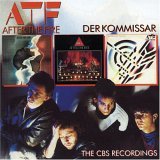 |
The
recent
two CD set, Der Kommissar: The CBS Recordings includes the
three CBS albums: Laser Love, 80-f, and No Batteries
Required, along with numerous singles never heard in the US.
The American compilation, ATF, had the cover art from No
Batteries Required but with different songs. For more
information, click on the picture. |
| Q:
The double CD set is by far the best thing we can get over
here. You had mentioned your album, Signs of Change. A:
That was our first album, and that was done before we were
signed and was self-financed through loans and things. We
did that back in 1977-78, and we sold that through our
front door, literally, at gigs and things. That was pretty
successful and that’s been remastered onto CD now, and
that’s on our own label again, so it’s come around twice.
The original record was six songs. On the CD you’ve got
four extra tracks, so there’s ten songs on the CD. So the
CD is a fantastic value package, and available from
Afterthefire.co.UK.
Q:
I’m looking through Steve Clark’s booklet, After the Fire:
Profile of a Rock Band. The people in the band have
changed so much and it looks like the styles changed so
much. Was that album done in a different style?
A: It’s a totally different style. It’s a very progessive rock style, like early Genesis and Yes and things like that. Some people still like it to this day. Q: You also played in a band called Narnia, which now with the movie would probably have some following. A:
Yes, although there were a lot of problems legally. The
C.S. Lewis Foundation would not let them use that name so
they had to change the name of the band. The foundation
obviously has got a more commercial outlook now. That was
the first band that John Russell and I played together in.
After he left Narnia he came and joined us.
Q: Steve Clark mentions your drummer, Ivor Twidell. He had a solo album after that I guess, but I thought it said Iva Twidell on it. A: Probably, I don’t know. Q: We know you toured the US with Van Halen. Were the tours with Queen only in Europe? A: Yes, Queen and ELO tours were both in Europe. Van Halen was just the states and Canada. Q: Are the rumours true that some of those shows were rather violent? A:
Well, there were four shows which were very violent, and
we either got injured or we had to retire early before we
got injured. Van Halen really took to us because they’d
not had a support band that was able to last very long on
the tour. Two weeks was about the maximum, and we lasted
for nearly four months altogether. We were very popular
with the crew and the band and they were very nice to us.
It was quite an experience, really. But there were four
dates, two in San Francisco at the Cow Palace, where we
had to leave the stage early for our own safety.
Phoenix,
Arizona, where the funny thing is that if we ever had a
gig that was a little bit tough, that would be it. We’d
heard, “Hey guys, wait ‘till you get to Phoenix, Arizona,
so we weren’t surprised. But it was pretty amazing. It was
incredible. We left the stage after about fifteen minutes
having been bombarded with loads of money, metal objects,
circular saws, vessels filled with varying liquids, loads
and loads of stuff. There was one other, I remember I got
hit by a coin on the side of the head, right next to me
eye. I was still playing away, and it felt like
bucketloads of blood running down my face. But we managed
to make it all the way through on that one.
Those
were the bad ones, but the rest, I mean we did over fifty
dates, so on a percentage base it was pretty good. In some
places we went down an absolute storm. We had some amazing
nights. I remember there was one down in El Paso, which
they said was going to be a really tough gig. There was
loads of very damp Mexican guys. Everyone was huddled into
this enormous cattle shed, and they couldn’t fit the whole
staging in there. It was a straight hall, there were no
banks of seating. It was much more intimate than the other
dates, and we went down an absolute storm on that night.
It was a really memorable night. I remember the crew
coming in and saying, “Hey guys, you did well tonight.”
Madison Square Gardens was really good for us. We went
down very well there.
Q: So you’re rising from the ashes of Phoenix. A:
We got our name from the story of the still small voice,
which is after all the earthquakes, wind and fire. It is
something different and it has a deeper meaning. So that’s
what After the Fire is about. (I Kings 19 verse 12).
Q: Of course I meant that as a joke on Phoenix, Arizona. A: Got it! Q:
When I reviewed whatever the American album was called in
those days--wasn’t it just called After the Fire? I was
writing for a magazine called Campus Life and I reviewed
it. I was convinced it meant the fire of Pentecost in the
book of Acts. I always liked “Laser Love” thinking about
it like that.
A:
I don’t have a problem with that. The thing that is so
clever about “Laser Love” is you can take it on two
levels. You can either take it as a straight love song or
you can take it as something deeper. The other thing about
it is it’s using contemporary language. It’s not using
Biblespeak gobbledegook, which doesn’t relate to people
today. That’s always a pretty timeless song, and it’s
still one of the most popular songs we do. I think it’s a
fantastic song. If there is one song that really sums up
what After the Fire is about, “Laser Love” is it, because
it’s very much the bouncy energy, gutsy music style, it’s
the pumping, rythmic thing that After the Fire is about.
Lyrically it’s absolutely brilliant. It has that subtle
level. It can be taken just as a love song or it can be
taken as something deep and meaningful. It’s also got the
audience participation bit with the shouts, the “oh oh
ohs” in the background. It’s just a great song and it’s
still really popular in our live sets.
Q: The single was awesomely beautiful with the orange record showing through the slits in the sleeve. A:
That’s right. No one had done that before. We started off
talking about having a hologram in there, but that turned
out to be pretty expensive. So we tried to come up with a
way of doing something and we worked in conjunction with
the record company to come up with that sleeve. It’s a
great sleeve.
Q: It’s fantastic. A: To me it’s a real pinnacle of Andy’s lyrical accomplishments. Very, very happy with that. Q: Another song I really like is “Time to Think.” A: That’s a great song. In the new set we’re doing “Time to Think.” It’s got some pretty amazing words. Q: It’s got a little bit of punk slacker in it. Can you talk about the new band and what you’re doing and where it’s going? A:
OK. We’ve now set ourselves a charter for the way forward.
We’ve got a five point plan. We’re trying to ensure that
everything we do falls into those five points so this will
cover both the recordings and the shows that we decide to
do. What we want to do is something different all the
time. So we want to play various styles. Not necessarily
rock all the time. We want to play unplugged shows, we
want to play radio shows where we would go in and play
live, and things like that.
The five points are very much based around After the Fire want to: 1. Have fun. 2. Maintain the brand name. 3. Always have integrity. 4. Work within our means. 5. Always try to make a difference. If
we break those things down, you can see that by doing the
AidTF thing, making a difference, providing that money for
that water. We want to change the way things are in the
world by making a difference. Having fun is really
important because we had our heyday. This is the second
bite of the cherry we’ve got now, so it’s not a major
commercial approach. So having fun both for ourselves and
for our audience. It’s very important we don’t damage the
brand name, so we will always work and promote what we’re
going to do as After the Fire. If it got to where people
really hated what we were doing we would have to
reevaluate why we were going forward. Maintain integrity.
We still want to have the aims and the missions that the
original After the Fire had. Working within means, so that
we do not go spending $30,000 producing a new album and
then only selling a handful of copies. We want to go
slowly. The new After the Fire organisation is a fraction
of the size both in record sales and infrastructure to the
professional band that was back in the ‘70s and ‘80s. So
that’s pretty much where we’re at.
Q: That’s a pretty good summing up. It reminds me a little bit of Mike Peters resurrecting the Alarm. A: Yeah, but that’s still a full time band, isn’t it, whereas we’re not full time. Q: Didn’t you also play Greenbelt once when Cliff Richard played? A:
That was 1979. I thought it was brilliant. It was a
fantastic year. You had Garth Hewitt, who had just signed
to Cliff Richard’s record label, so he had a commercial
record deal, so he was going places. Cliff Richard was
number one with “We Don’t Talk Anymore.” We had the Laser
Love album coming out. We had already been in the charts
with “One Rule for You” and we were just at the pinnacle
at the Greenbelt time. You had Bryn Haworth out on EMI or
something like that, on a commercial record label. And it
was just fantastic.
Q: We got some Cliff Richard albums here because they came out on Rocket, Elton John’s record company. A: It always grieved Cliff that we outsold him in the states. We got a much higher chart position with number five for “Der Kommissar.” |
Text
©
copyright Gord Wilson 2005, images copyright After the Fire.