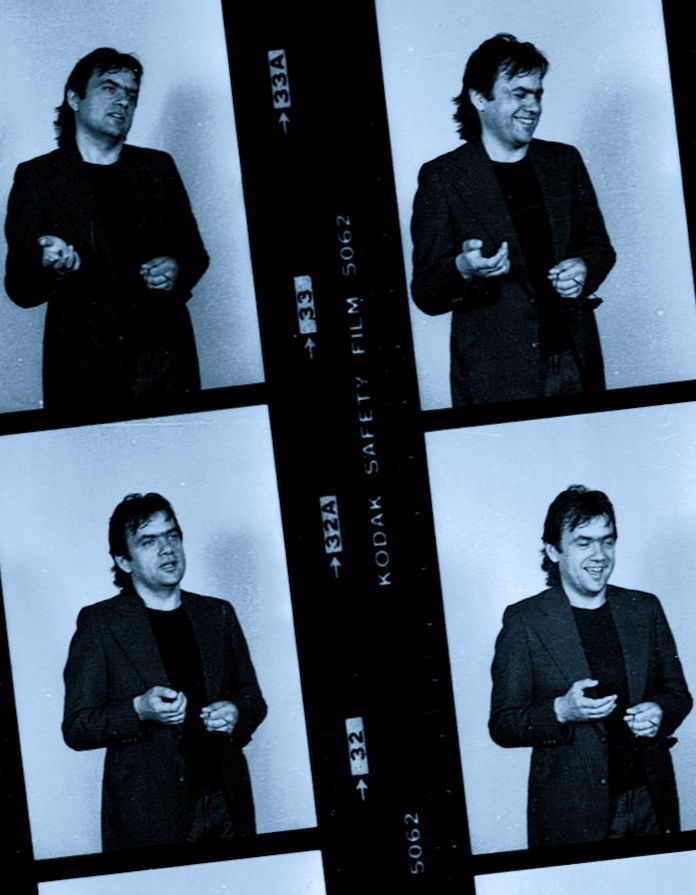
Who's
Steve Scott? Two interviews
|
Q
and A with HM:
an
interview with
Steve Scott
by Doug Van Pelt. August
2009.
Excerpts
from this interview
appeared in the
Sept./ Oct. issue of HM. Used by permission.
|
|
Q.
Name 3 bands that, had they
not
released a certain album at a certain time, you would not
exist
as an artist.
A:
The Beatles,
Leonard Cohen, Gavin Bryars.
Q.
If there wasn't
music, what skills would you use and what would you do?
A:
I'd concentrate more
on
making (better) visual art and I'd do more writing.
Q.
When
asked to
describe yourself by comparing yourself to others, who would
you list?
A:
No idea. I could list
the different artists I like for different
reasons....but
whether I'm anything as good as them, or if I have
unconsciously
borrowed from them is really not my call.
Q.
What's a secret or
little-known fact about you that would make you the darlings
of the
music world if we all knew it?
A:
I still write songs.
Larry Norman, 77s have covered stuff. I'd like more covers.
I'd like to
write for people.
Q.
If there was another
band and another album that you could give everyone as a
present for
Christmas, what album would that be? Why?
A:
Comsat Angels
`Fiction' Strong album by under appreciated band
from late
70s/ 80s/90s. Chiwoniso Maraire `Rebel
Woman' Amazing voice, songs and Mbira.
Q.
What is one belief,
conviction, idea, or passion that you honestly think
might've been
deposited inside you or given to you by God?
A:
The Gospel of John is
an
important text to consider when thinking about Christian Art
and
culture(s)
Q.
What's
one of the
most memorable things (either good, bad, or funny) that's
happened at
one of your shows?
A:
Performed `No Memory
of
You' at a 'Christian' coffee house (this is a spoken word
piece using
looped background of Indonesian prostitutes talking)
During an
intermission some Christian truck drivers wanted to take me
to one side
and `show me the way of the Lord more perfectly...'
Q.
If you had a chance
to perform for most of the televised world and play just
one song,
which song would you play ... and why?
A:
(In theory) `No Memory
of You'...to me...its so sad, and even more relevant
today.
Q.
If a
super surgeon
removed all of your emotions and the ability to feel any
emotion for
the rest of your life, which one or ones would you most want
to have
back? Why?
A:
I'd like grief and joy
back, please...and maybe anger. Serenity would be good.
Feeling the
right things at the right time, and doing something
(constructive) with
or about them.
Q.
If you
could ask God
one question, what would you ask Him?
A:
How did something so
simple end up so complicated?
Q.
What's the best
video on youtube (if our readers had to type in a word or a
few
to search it, what would the keywords be?)?
A:
There's a youtube clip
of the Comsat Angels performing `After the Rain' and
'What Else'
off 'Fiction.' (Comsat Angels live 'after the rain').
There's
a
youtube clip
of Nicolas Bourriaud, current director of Tate Modern, I
think...explaining why Postmodernism is dead, and comparing
today's
artists to computer programmers and Turntablist style DJs
(Bourriaud
Altermodernities)
There's
a
youtube clip
of Chiwoniso performing at the Luna Cafe.(Chiwoniso live
luna)
Q.
If someone came to
you and said, "Hey! I need to make some changes in my
life...Help me
out! I'm going to take one piece of advice from you and
apply it to my
life and/or make it a habit for 30 days. What would that
piece of
advice be?"
A:
Read the Gospel of
John (a lot!!), call me regularly and let me know what
you think.
Q.
In 4
sentences or
less, explain how you as a creative entity (as a solo
artist) came to
exist (and give us a date).
A:
Official four
sentences:
When
I
left art school
in the mid 1970s, I was not a very good artist, and I really
did not
understand or emotionally connect with much art.
When
I
came to USA in
late 1970s, I hoped to survive as a singer/songwriter, and
spend time
thinking about and exploring the 'real' art that I
liked.
During
the
1970s/80s I
found myself thinking about the different
relationships/connections
between art and faith more deeply...I hoped this showed up
in what I
was performing and writing.
When
I
got off the plane
in Bali, Indonesia in the late 1980s, everything began to
connect/ integrate/ make sense in a new kind of way.
Q.
Please
list all of
your album titles, instruments played, book titles, and
location/ hometown.
A:
BORN IN WALTHAMSTOW,
LONDON : LIVE IN SACRAMENTO,
CALIFORNIA.
OK, on the fly from
memory. approx dates.
ALBUMS:
`Moving
Pictures'
(unfinished/unreleased) Solid Rock Records 1978-?
`Love
in
the
Western World' Exit records 1982
`Lost
Horizon'
Alternative
Records 1989(ish)
`Magnificent
Obsession'
Alternative
Records 1991(ish)
`The
Butterfly
Effect'
Blonde Vinyl 1992 (ish)
`Empty
Orchestra'
Glow
Records (1993/4)
`We
Dreamed
that We Were
Strangers' Glow Records(1996)
`More
than
A Dream'
Glow/Radrockers (i think!!) (1997)
`Crossing
the
Boundaries'
Glow/Radrockers (1998 ish)
`Love
in
the Western
World (with bonus tracks) CD reissue m8 records (2000)
'Emotional Tourist: A Steve Scott Retrospective' Arena Rock
(2012)
BOOKS
OF
POETRY
`Ghost
Dance'
Monolith
Books, London 1976
`AfterImages:
Boundaries
vol
1 (self published)
California
1991
`The
Saint
Petersburg
Fragments: Boundaries vol 2 Cornerstone Press, 1993
`Out
of
Order: (Dutch
materials) Boundaries vol 3 Inertia Books,
Kansas City 1994.
BOOKS
ABOUT
ART
`Crying
for
a Vision'
Stride books UK 1991
`Like
A
House on
Fire' Cornerstone Press, 1997
`House
on
Fire (reprint)
Wipf and Stock 2003
`Crying
for
a Vision
(expanded) Alivingdog/Authorhouse 2005
Q.
What
is the release
date of your next (or latest) album? Or what is the next big
date on
your calendar?
A:
`Emotional
Tourist' (retrospective album) early 2010, Arena Rock
Records,
Portland Ore.
Currently
in
the
works????
Well,
in
addition to the
Arena Rock retrospective album, I'mcreating/ finishing
up more
sound loops from my travels to accompany another
spoken word
project (working title: How Many Words for Sorrow?).
My
next `book on the
arts' will be a reflective/ devotional
commentary on the
Gospel of John ( title: `The Wedding at Cana '). I'm writing
it now,
will blog sections soon, and already have an interested
publisher.
Q.
What is one of your
most lasting memories of St. Petersburg , Russia ?
A:
Visiting a children's
hospital ward. We were in a side room crammed with kids.
Geoffrey Stevenson did a mime piece, and then while
Graham
Kendrick led all the kids in a Russian language version of
'Shine Jesus
Shine'....a small worship team from Korea (apologies
to them:
cannot recall exact name of group) did a beautiful fan
dance. To say
'you had to be there' is an understatement.
More
background
on Steve
Scott and his works can be found at:
http://en.wikipedia.org/wiki/Steve_Scott_(poet)
which
includes
a link to his
1990 ACM Journal
interview:
http://www.acmjournal.net/i05-ssc.htm
|
Door
Number Two An
Interview with
Steve Scott by
Gord Wilson, April 2007.
Q: Well Steve, now that your
book, Crying
for a Vision and Other Essays is out, how do you
feel about it?
A: In many ways I am glad
Crying
is back out, because I hope it draws
attention to the companion volume 'Like a House On Fire' and clears the
way for a new book I'm writing,
In
the Shadow of God. In other ways I
am saddened by the state of things. Last summer I was at the Los
Angeles Museum of Contemporary Art, and I spent hours in the Robert
Rauschenberg 'Combines' show. Some twenty years ago, I stumbled across
an interview with Rauschenberg in which he explained why he left
the Church of Christ as a teenager. He could not understand why
he had to live in fear of someone else’s possible reaction or
'stumbling' if they happened to see him dancing (for example.).
Rauschenberg abandoned his early aspirations as an evangelist, and went
into the world of contemporary art. The artist has stated that he wants
to `stand in the gap’ (sound familiar?) between art and life. As I
wandered through his show, and caught what I felt were occasional faint
allusions and references to Biblical themes and images, I sensed that
the church’s loss was the art world’s gain. As I look at some of
what is offered in the name of `Christian art’ in today’s postmodern
and multicultural world, I feel like there is still a lot of ground yet
to cover, and that in some ways the mindset that Rauschenberg
encountered is still around. It is on days like that that I feel
that Crying for a Vision is a very tiny drop in a rather large bucket.
Q: The core of the book is
Crying for a Vision, which was
originally published in Britain in
1991 and distributed in the US by Cornerstone Press.
A: Not really. The relationship was much more informal than that. Let
me explain.
Rupert Loydell connected with me by mail in 1989 or 90. He was a
published poet and widely exhibited painter in the UK who also ran a
small press called STRIDE. The press published a magazine, books of
poetry and art criticism, and all stops in-between. We began to discuss
a small run of books of my arts essays. Hence `Crying for a
Vision’. This was made up of essays and lectures published and
delivered from the early 1980s on. Rupert, at that time, was also on
the Fine Arts committee of an arts and music festival in UK called
Greenbelt. He got me invited to do some lectures there, and launched
the book.
During those years (90-on), I had been a lecturer for Cornerstone
Festival's `Artrageous Seminar’. So in 1992, the guy then
overseeing it (Bruce Bitmead) decided to invite Rupert plus other
worthies over from the UK . I think Rupert was over in 91 also.
ANYWAY 92 was a good year, because Rupert, Steve Fairnie and others
descended upon the Cornerstone crowd and nothing was ever the same.
I have fond memories of a hotel room, late at night (or early morning)
with Rikki Michelle, Mike Knott, Jim Abegg and others, and Steve
Fairnie attempting to hypnotize someone. Some years earlier
Fairnie was actually in the Guiness book of records for hypnotizing
chickens.
ANYWAY, at this time, Cornerstone Press was about to get going, and
there were lots of informal discussions between those running the press
and Rupert. Out of those conversations came a whole slew of poetry
chapbooks, featuring myself, Rupert, Evangeline Patterson and so
forth. Also, Mike Knott (Blonde Vinyl) had just put out my `Butterfly
Effect’ album project. All this to say there were no formal
distribution relationships as far as I can recall, just a lot of
tangled connections and informal cooperation.
Q. You've been called a
Renaissance Man in an age of specialists. You don't fit a narrow
groove. Your interests seem to range widely. You seem, if I may use the
expression, too bloomin' alive to be confined to one thing. This bodes
badly in an era of niche marketing. I think Bono has the same problem,
and has simply decided to use his name and fame to further his causes.
So, what’s going on here? How do you do what no one else seems able to
do?
A: This `no one else’ is flattering, but I can think of plenty of
people who work across genres and media. Art school in UK from
the 60s on bred that kind of mindset. Early 60s Art school, of course,
is better known for people who got into the blues and rock music and
stuff. Mid 60s on it was all alternative, psychedelic, mixed media. In
the late 60s I used to hang out at Jim Haynes Arts Laboratory in the
center of London…this was combination gallery, wholefood
restaurant, theater, movie house and all points in-between
, poetry readings, experimental drama, underground film and
experimental mixed media events. I saw Mark Boyle’s liquid
theater at the arts lab (he did lights for the Soft Machine) and on
into other hybrid mixed media art events.
In 68, I saw the Bread and Puppet theater at London’s Royal court
theater, and I also to hang out at bookstores like Betterbooks, Indica
and then, later, Compendium. All this to say that transmedia/
transgenre was very much in the atmosphere, and on into the 70s when
the influences of conceptual and performance art entered the mix, also
keep in mind that stuff in the early to mid 70s
channeled some of the more aggressive and adversarial aspects of
the social theory fueling much of art mix into something that
came to be known as `punk rock', but by now (mid 70s on) the artist was
someone with an idea or an attitude who chased that idea and
attitude (sometimes via a persona) through all kinds of media.
David Bowie. He’s a good example. Steve Fairnie is another.
Fairnie was someone who would turn up on children’s TV as a Charlie
Chaplin look-alike, turn up in the club and pop charts with his wife
Bev as `the Technos’ and turn up in the offices at Virgin punting a
board game he was working on based on the ins and outs of the
record business. All this from a guy who I think was studying painting
and sculpture at the Royal College of Art. Bev was a
photographer, but she was out and about doing voice overs and rap on
some of the early club and house stuff. It helps (maybe) if we look at
the shift between modern and postmodern culture. If we can associate
`classic’ modern art, painting sculpture etc as being concerned with
the exploration of `formal’ (design and material) relations, then we
can look at genre bending post modernists like Steve Fairnie as
making art by exploiting pop culture public relations. In fact, since
his untimely demise in the early 90s, his influence has continued to
grow. Dave Tomlinson dedicated `The Post Evangelical’ to him. There are
websites up about him now. He may not have been a household name as a
rock star, but I understand that Bono was at his funeral.
Left
to
Right: 27th and 4th by Robert Lax, illustrated by Steve
Fairnie,
Stride Books, 1994; The Museum of Light by Rupert Loydell, Arc
Publications, 2003; Closed Volumes: Stride Magazine no. 36,
Stride
Books, 1994.
|
Q: OK, so you came to the
states, because?
A: Well, Larry Norman had expressed interest in my songs and we were
seriously talking record deal. And as I say in the interview in
Crying for A vision, there’s someone else who is a pioneer. I think he
is due a lot more than he’s currently getting. Also, let's keep in mind
that it was his initial interest in my work and the generous support of
him and Randy Stonehill that made it possible for me to come here
in the first place, just as the ongoing support and generosity from
Louis and Mary Neely and Warehouse Christian Ministries made it
possible to remain here.
BUT I also came to USA for the ART. Many of the artists I liked were
living and working here. Robert Rauschenberg for example. Film makers
like (the late ) Stan Brakhage. I was in New York in the early 1980s,
and attended a free in person appearance by Brakhage at the museum of
Modern Art , and a retrospective screening of his hand painted films.
Unbelievable. Amazing to be in a San Francisco hall in the late 1970s
and hear poets Allen Ginsberg and Robert Duncan read, or to run into
Duncan in a vegetarian restaurant and ask him where I could find a copy
of one of his earlier poems, or seeing Kenneth Rexroth read poems
accompanied by a Japanese Koto player. Unbelievable to be in a San
Francisco church hall twenty or more years ago and shake hands
with the Swedish poet Tomas Transtromer.
When I was finishing up at art school in UK , I was talking with
faculty and we were discussing `what next?’ and one of them said
`Well, you could go on to another college and write a Graduate
thesis about the work of (German Performance artist) Joseph Beuys, or
you could go to Berlin and have a drink with him. So, in a manner of
speaking, I chose door number two.
Q: And came to US.
A: Yes, in some ways, I keep going through door number 2. The travels
in Asia and stuff.
Q: The stuff you’ve written
about in The Boundaries?
A. Well yes, that’s an ongoing writing project that spilled over into
some of my recorded work. When I left art school and came to US I was
still trying to think what to make art `about’, in addition to the
songs I was writing for the early recording projects. As I began
to travel for different reasons, I began to write stuff down, and the
resulting little chapbooks consisted of a mix of poetry, travel
journals and so on. And then I began to record some of the poems over
sound loops and put them out on albums, then I’d travel to promote the
albums, and keep journals about the traveling to promote the records.
So the work spilled across the boundaries of poetry and prose, across
the printed page and the CD, and the work kind of looped back on
itself and incorporated commentary on its own processes. As well
as a record of my own writing exploration, it served as a kind of
mirror of my own spiritual exploration.
Q: Would you call that an
emerging liquid ancient- future?
A: Don’t even go there.
Q: Well all this sounds a bit
inward and arty. But isn’t it in your travels that you met other
artists in other cultures and got involved with CANA (Christian
Artists' Networking Association)?
A Well, yes, I got involved with the arts organization that I now
direct (CANA). We run conferences in Asia and Eastern Europe . I
also got to collaborate with other artists. While speaking at the afore
mentioned Cornerstone, I hooked up with painter and mixed media artist
Gaylen Stewart, and we did a mixed media collaboration using his
paintings, my soundloops and poems, all centered on the theme of nature
and natural processes. It went to several galleries in the US, and I
took a slide lecture based on the project to arts events in the
Netherlands , Eastern Europe and also the People’s Republic of
China.
Q: You provide a detailed
description of your ideas and working process during this project in
Crying for a Vision and Other Essays, and I think you and Gaylen talk
about the collaborative process in the new version of `It Was Good:
Making art to the Glory of God’.
A: Absolutely. Hunt those books down.
Q: Earlier, Bono’s name came
up. Cross paths back in the day?
A: Nope. Never met him, probably never will. The only thing we remotely
have in common is that we both knew Steve Fairnie.
Q: But you’d like to…
A: We might yuk it up for a couple of minutes over my collection
of Balinese and Javanese shadow puppets, but after that I’m not sure
what we’d find to talk about.
Q: Only everything.
A: OK, five minutes with the lad? I’d fire up my laptop and spend 2.5
minutes cycling thru images of artwork, painting and sculpture by
Claudia Alvarez. I’d spend the other 2.5 discussing the work of Malawi
Gospel recording artist and activist Chimwemwe Mizaya.
Q: Thank you, Steve. And
there's our five minutes with Steve Scott.
©
Gord Wilson, 2007. We support Content Sharing and Creator's Rights.
Please attribute quotes or content from this site to alivingdog.com.